I Am the Support Team: Running a SaaS When Support Is Also You
Founder-led support is useful; founder-dependent support is not. How SaaS founders build a support system, automate repetition and keep humans for judgement.

TL;DR
- One support message is really seven jobs: answer, understand, investigate, reproduce, resolve, explain and follow up.
- The biggest cost of support is attention — the context switch, not the minutes on the timer.
- Build the system before buying the tool: one place, five repeated questions, written answers, clear automation boundaries, realistic expectations.
- Automate repetition, not judgement — every automated support system needs an exit to a human.
- Hand support over when you become the bottleneck, starting with the questions that already have documented answers.
It’s 11:07 p.m.
The laptop is technically closed. You’ve already answered emails, checked the day’s numbers, pushed a release, and told yourself that tomorrow you’ll finally get a few uninterrupted hours to work on the product.
Then your phone lights up.
“Hey, is this supposed to happen?”
It’s a customer.
You know the answer will probably take two minutes.
So you open the laptop again.
Two minutes becomes checking the customer’s account. Then the dashboard. Then the logs. Then trying to reproduce the problem yourself. Maybe you find something strange and send a message to a developer. Maybe you discover it isn’t actually a bug. Maybe you need to explain something that was obvious to you but not obvious to the customer.
By the time you close everything again, it’s 11:46.
The support team is asleep.
The support team is also you.
For an early-stage SaaS founder, this is normal.
You answer the messages. You investigate the problems. You explain the product. You chase bugs. You apologize when something breaks. You follow up when the fix is ready.
And in the beginning, that is often exactly what you should be doing.
The problem isn’t that the founder does support.
The problem starts when support becomes completely dependent on the founder.
At first, founder-led support gives you something incredibly valuable: direct access to your customers. Eventually, though, the same inbox that teaches you what customers need can start consuming the time you need to build the company.
This isn’t just a theoretical pattern.
Pylon, for example, has described its early support motion as entirely founder-led. Its founders personally handled customer conversations while also designing, building, and selling the product. They eventually reached a point where the volume made that model impractical; by mid-to-late 2024, Pylon says it was averaging more than 950 issues a month across more than 250 customers. That was the point at which it began building a dedicated support function.
That progression is important.
The lesson isn’t that founders should avoid support.
It’s that the thing that works at ten customers may not work at 250.
This is the uncomfortable transition every small SaaS eventually faces:
Founder-led support is useful. Founder-dependent support is not sustainable.
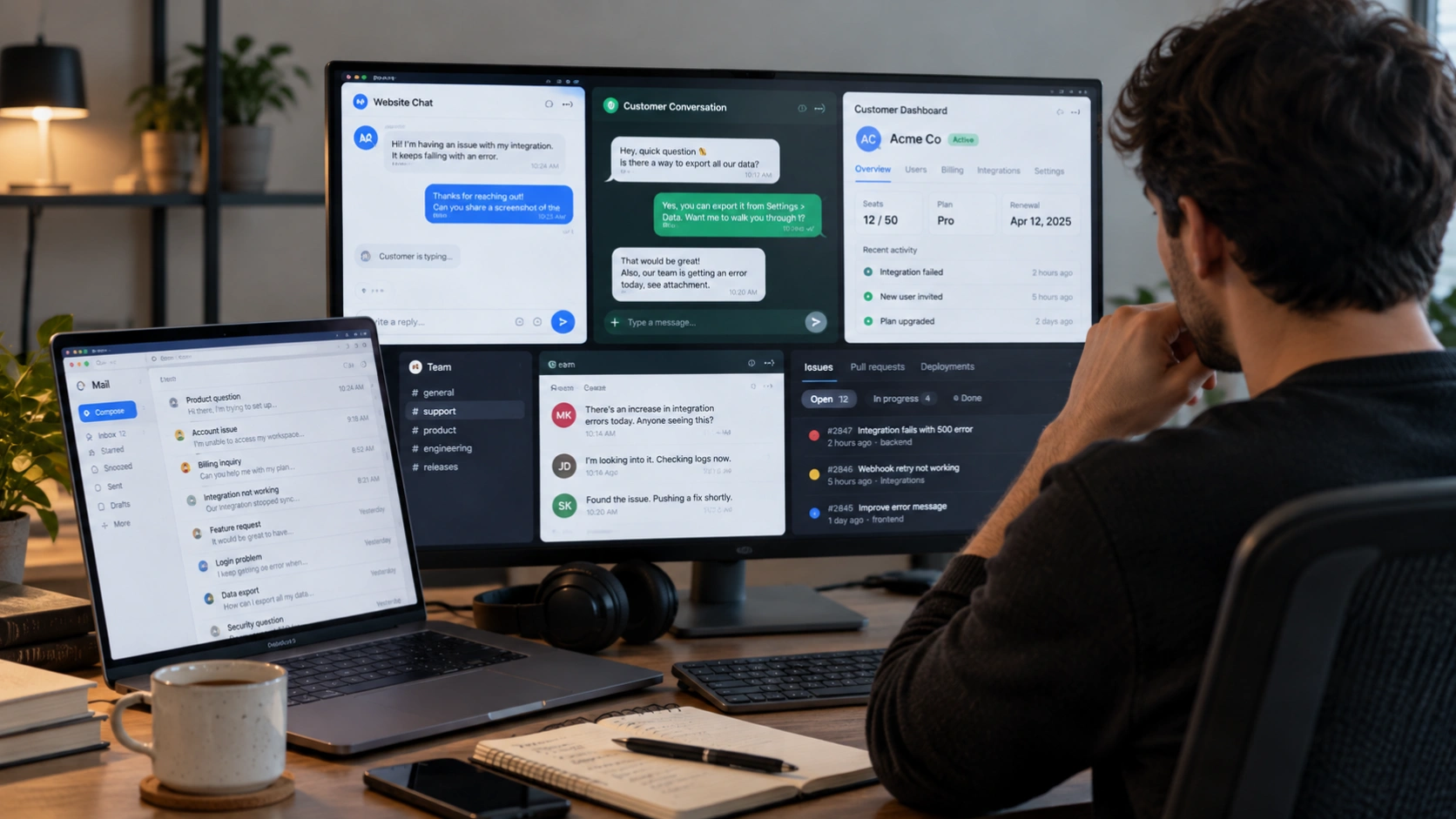
What “I Am the Support Team” Actually Means
When founders say, “I handle support,” it sounds like one job.
It isn’t.
It is usually several jobs hiding inside one inbox.
You answer the customer’s question.
Then you decide whether the question is actually a bug.
Then you reproduce the problem.
Then you figure out whether someone else needs to fix it.
Then you chase that person.
Then you return to the customer and explain what happened.
And sometimes, after all of that, you realize the customer misunderstood a part of the product that you assumed was obvious.
So the real workflow looks more like this:
Answer → understand → investigate → reproduce → resolve → explain → follow up.
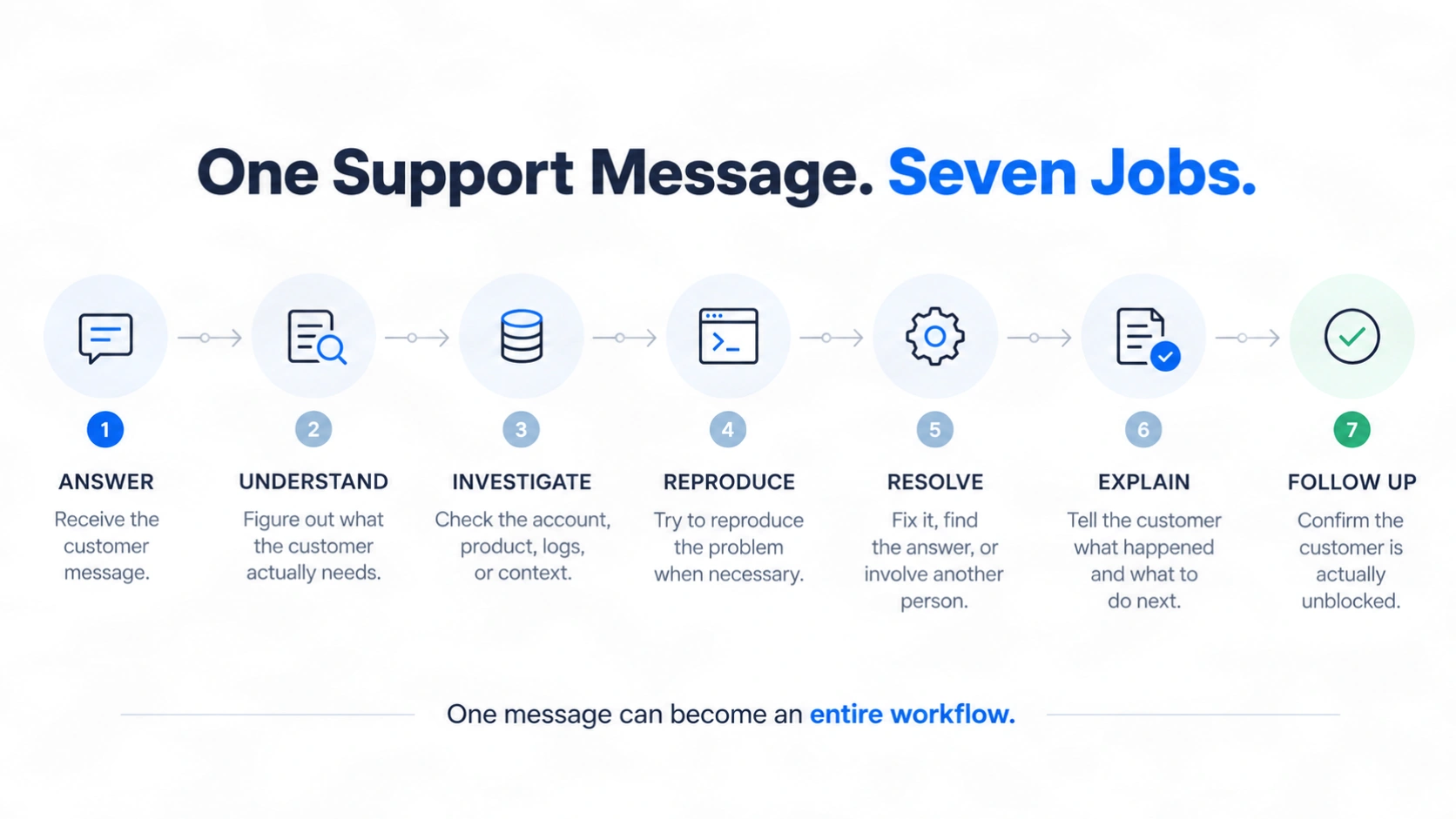
None of these steps necessarily feels huge.
That’s what makes support difficult for a founder.
A two-minute question doesn’t look like a two-minute interruption.
It might take two minutes to read the message, ten minutes to understand the context, fifteen minutes to reproduce the issue, another ten minutes to check something internally, and another five minutes to write the response.
But there is another cost that doesn’t appear in the timer.
You had to stop what you were doing.
If you were writing code, you lost your place.
If you were designing a feature, you changed mental context.
If you were preparing a sales call, you switched into customer-service mode.
And after the conversation is finished, you have to switch back.
Support is therefore not just a communication problem.
It’s an attention problem.
Research on workplace interruptions backs up the broader idea. A systematic review of 33 laboratory experiments found that interventions designed to reduce the negative effects of interruptions improved primary-task accuracy and reduced the time people needed to resume their original task. Other research has similarly linked unexpected interruptions with additional effort, task-switching demands, and resumption lag.
That research isn’t specifically about SaaS founders.
But the underlying problem is familiar: every support message can become an interruption to another piece of work.
And support has no natural off switch either.
There is always another message.
Another question.
Another “quick thing.”
Another customer who needs an answer before tomorrow.
Because support is usually reactive, it rarely gets planned properly. Product work gets a roadmap. Sales gets targets. Marketing gets a content calendar.
Support often gets:
“I’ll check the inbox when I have time.”
And somehow, there is never enough time.
Why Founders Should Do Support First
Despite everything above, founders should probably do support.
Especially in the early days.
Not forever.
But long enough to understand what customers actually experience.
There is information inside a support conversation that you won’t find in an analytics dashboard.
A customer might tell you:
“I can’t find where to connect my account.”
You might initially think that means they need better documentation.
But perhaps the real problem is that the button is in the wrong place.
Another customer might ask:
“What does this feature actually do?”
That isn’t necessarily a support question.
It might be a positioning problem.
Your product may make perfect sense to the team that built it while remaining unclear to someone who has never seen the internal architecture, terminology, or assumptions behind it.
Customers don’t experience your product the way you designed it.
They experience it the way it behaves.
That’s why early founder-led support can be one of the best sources of product feedback available.
And there are founders who have made that argument from direct experience.
David Heinemeier Hansson has described how Jason Fried handled customer service himself when Basecamp launched in 2004, continuing for roughly three years before the company hired its first customer-service employee. In another account from the Statuspage team, the founders described deliberately keeping support and operations founder-led until those responsibilities began taking meaningful time away from building the product and growing the business.
These are older examples, and their companies and circumstances were different.
But the underlying pattern is useful:
Early support can be product research.
It shows you where people hesitate.
Where they get confused.
Where they expect something different.
Where the product makes sense.
And where it doesn’t.
There is also something else valuable about early founder support: speed.
When there are twenty customers and you personally answer a question in five minutes, that can create an experience a much larger company struggles to provide.
You know the product.
You know the customer’s context.
You can often solve the problem without passing the conversation between three departments.
That is a real advantage.
But there is an important distinction:
You should learn from every support conversation. You don’t need to personally handle every support conversation forever.
The goal isn’t to escape the customer.
The goal is to turn what you learn from customers into a system.
Because if the same question is answered fifty times, you haven’t just discovered fifty support requests.
You’ve discovered something that should probably exist outside your head.
Where It Starts to Break
The breaking point usually doesn’t arrive as one dramatic event.
It happens gradually.
At first, there is one inbox.
That’s manageable.
Then customers start reaching you through the website.
Then someone messages on WhatsApp.
Then another customer sends an email.
Someone else asks a question through another channel.
Maybe there is a social message too.
Suddenly, support isn’t one inbox anymore.
It’s several places that you have to remember to check.
And the problem becomes bigger than the number of messages.
It becomes the number of contexts.
You open an email.
Then a website conversation.
Then WhatsApp.
Then the customer dashboard.
Then your application logs.
Then Slack to ask someone about a bug.
Then GitHub to check whether an issue already exists.
Then back to the customer.
Then another message arrives.
None of these actions is particularly difficult.
Together, they can destroy a morning.
Five customer messages don’t necessarily cost five minutes.
They can cost an hour because every message asks your brain to move somewhere else.
That is the context-switch tax.
And there is broader evidence that digital communication can fragment attention at scale. Microsoft’s 2025 Work Trend Index, based on aggregated Microsoft 365 telemetry, reported that its highest-ping users were interrupted about every two minutes during core work hours by meetings, emails, or chats. The figure is not SaaS-specific and should not be treated as a measurement of founders, but it illustrates how quickly multiple communication channels can compete with focused work.
And it becomes especially painful when questions repeat.
You know the answer.
You’ve written it before.
Maybe you’ve written it twenty times.
But because the answer lives inside your sent messages instead of somewhere reusable, you write it again.
And again.
And again.
Eventually, you may even start answering the same question differently.
Not because the product changed.
Because you did.
One day you have time to explain everything.
Another day you’re rushing between a release and a sales call, so the response is shorter.
A week later, the same customer asks again and gets a different explanation.
That inconsistency creates another problem.
The customer doesn’t know what to expect.
Then there is the timezone problem.
A customer writes at 9 p.m.
You see it at 9 a.m.
From your perspective, you answered the next morning.
From their perspective, they waited twelve hours.
Nothing necessarily went wrong.
But the experience still felt slow.
This is where founder support quietly changes character.
In the beginning, it is:
“I want to talk to customers.”
Later, it becomes:
“I can’t build until I clear support.”
That’s the point worth paying attention to.
Because the biggest danger isn’t that support becomes difficult.
It’s that support starts determining what you work on.
The Costs Nobody Counts
Support has obvious costs.
Someone has to spend time answering messages.
But the less obvious costs are often more important.
The feature that didn’t ship
You planned to spend the morning finishing a feature.
Instead, you spent the morning answering customers.
The feature moves to tomorrow.
Tomorrow becomes Friday.
Friday becomes next week.
Nothing looks broken in your metrics.
But product velocity has quietly decreased.
The customer who never complained
The loud customer is easy to notice.
They send messages.
They follow up.
They tell you when something isn’t working.
The quiet customer is harder to see.
They stop logging in.
They don’t complain.
They don’t ask for help.
They simply don’t renew.
Support doesn’t always show you the customers you lost.
Sometimes it only shows you the conversations you had.
The quality of your own replies
Your first ten support conversations might get thoughtful answers.
Your five-hundredth might get:
“Please check the documentation.”
Again, this isn’t because you suddenly stopped caring.
Repetition changes behavior.
When the same question arrives over and over, the natural instinct is to shorten the answer.
That’s another reason support needs systems.
Not because humans are bad at support.
Because humans shouldn’t have to repeatedly solve the exact same problem from scratch.
And then there is the cost that is hardest to put into a spreadsheet:
your attention.
The most expensive support conversation isn’t necessarily the one that takes an hour.
It might be the three-minute interruption that happens five times every day for six months.
Build the Support System Before Buying the Tool
When founders realize support is becoming a problem, the natural reaction is often:
“I need a support tool.”
Sometimes you do.
But software shouldn’t be the first step.
The first step is understanding the system you actually need.
There are five things to do first.
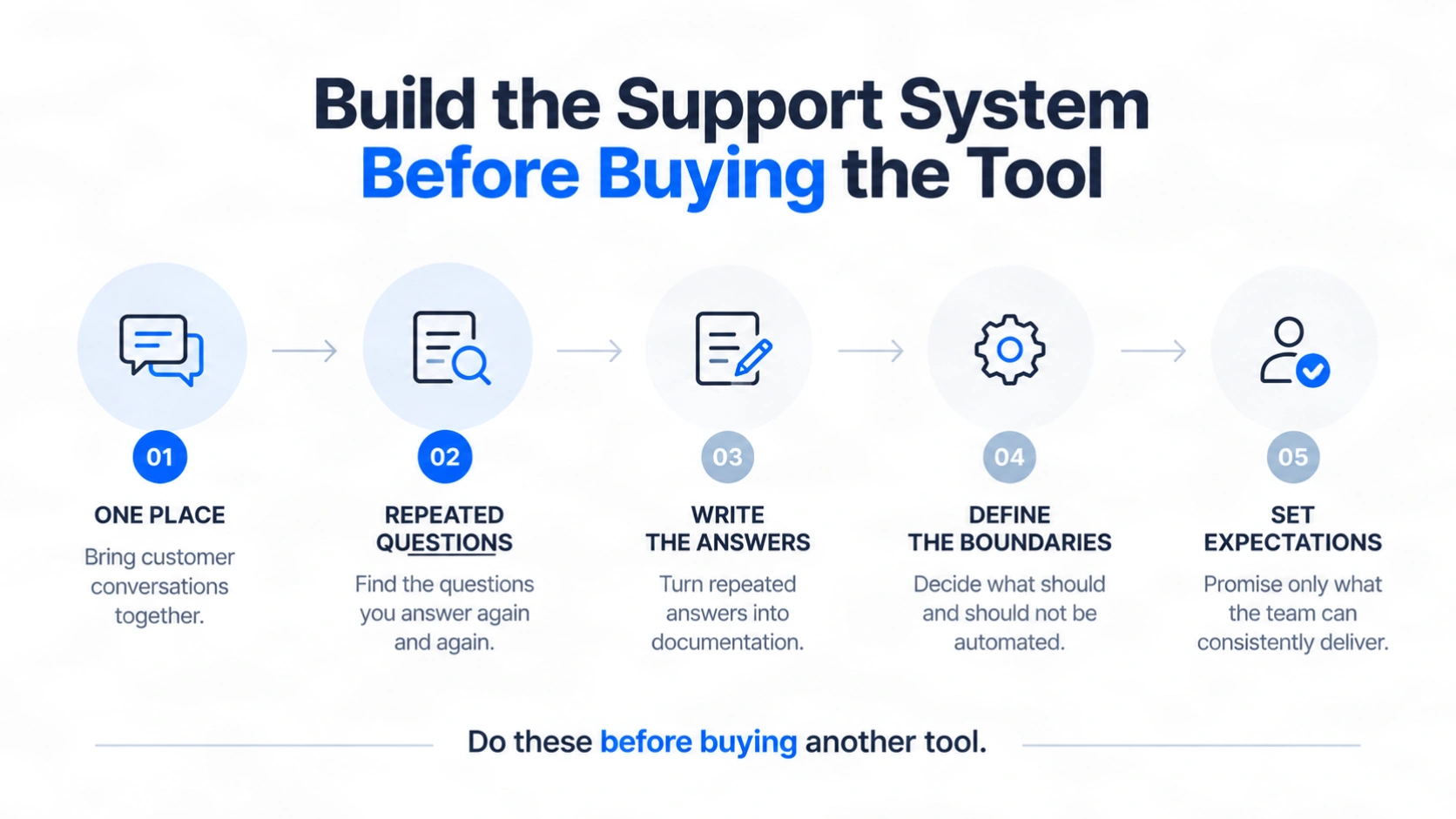
1. Put everything in one place
Start by answering a simple question:
Where are customers talking to us?
Email?
Website chat?
WhatsApp?
Something else?
You need to know where conversations are happening before you can decide how to manage them.
If customer communication is spread across five different places, your first goal isn’t automation.
It’s visibility.
You should be able to see the conversations that require attention without remembering five different places to look.
2. Find the five questions you’re tired of answering
Don’t invent them.
Open your sent messages.
Look through recent conversations.
Find the questions that keep appearing.
Maybe they are:
- How do I connect my account?
- Where can I find this setting?
- Why isn’t this working?
- How do I change this?
- Does the product support this use case?
Those questions are valuable.
They are the beginning of your support knowledge base.
And they are also clues about your product.
If customers repeatedly ask where something is, perhaps the interface needs work.
If they repeatedly ask whether something is supported, perhaps your website needs clearer messaging.
Support questions aren’t just tickets.
They are product signals.
3. Write the answers down
This sounds obvious.
It is also one of the most commonly skipped steps.
Founders often try to automate answers before they have properly written them.
That’s backwards.
Writing comes first.
Take the five questions and write five clear answers.
Not five answers that only you understand.
Five answers that someone unfamiliar with the internal product can follow.
Once an answer is documented, it becomes reusable.
It can become a help article.
A saved response.
An onboarding message.
An internal support reference.
Or eventually, an automated answer.
4. Decide what should never be automated
Before deciding what automation should do, decide what it shouldn’t do.
Some conversations need judgement.
Some need empathy.
Some involve money.
Some involve security.
Some involve an angry customer.
Some involve a situation nobody has documented before.
Those conversations should have a clear path to a human.
5. Set expectations you can actually keep
If you’re one person, don’t promise a five-minute response time because it sounds impressive.
Set a response expectation you can realistically maintain.
If customers know what to expect, waiting becomes much less frustrating.
The goal isn’t to pretend you’re a 50-person support organization.
The goal is to create a support experience that matches the company you actually are.
These first steps are surprisingly powerful.
And they don’t require buying anything.
They require an afternoon.
The irony is that founders often skip the afternoon because they are too busy dealing with support.
What to Automate — And What Never To
Once the basics are in place, automation starts making sense.
But there is a useful rule:
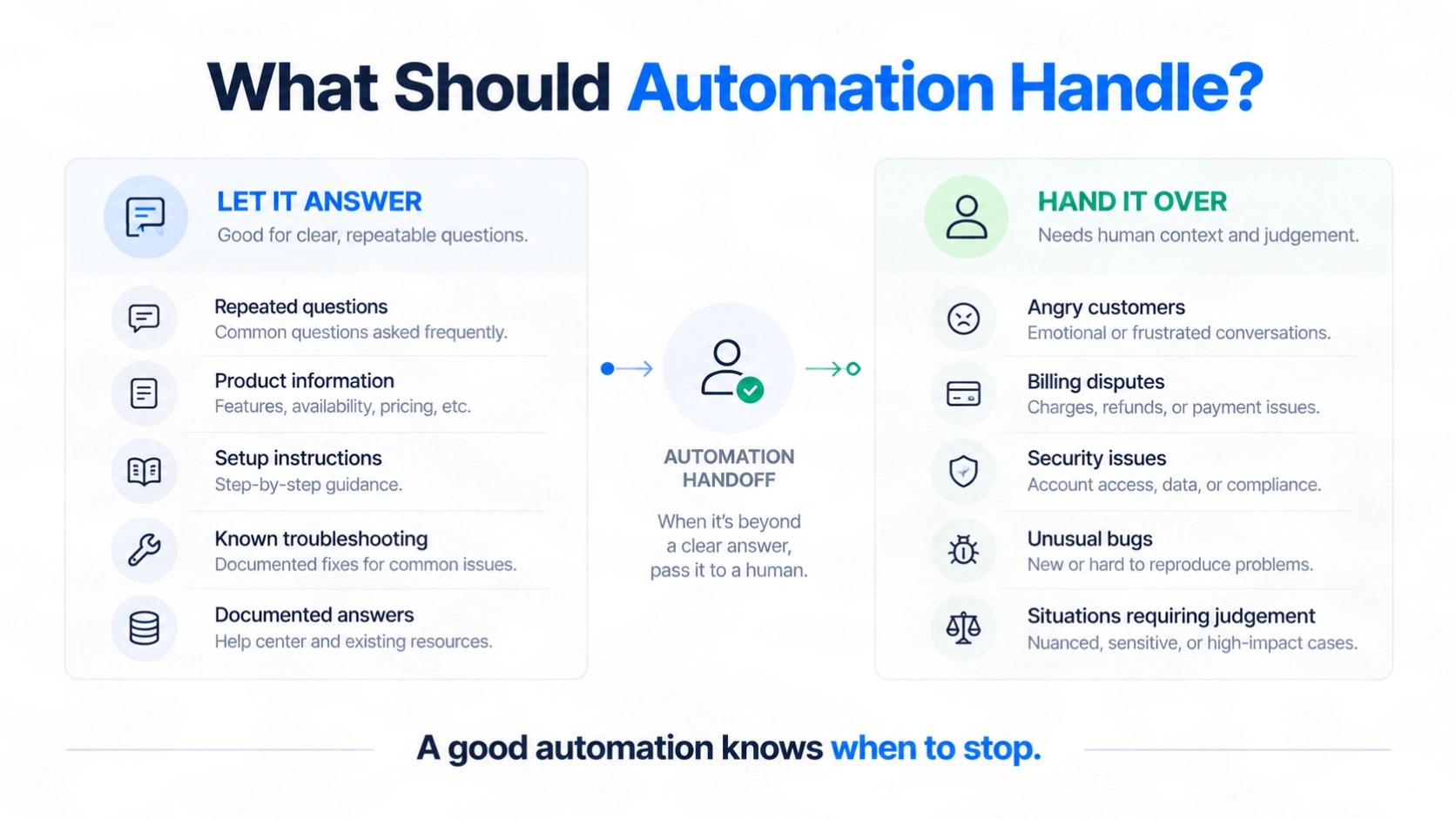
Automate repetition, not judgement.
Automation is good at questions that are:
- repetitive
- factual
- documented
- predictable
If a customer asks how to reset a password and you have a clear documented answer, there is little value in requiring a founder to type the same response every time.
The same applies to product information, setup instructions, known troubleshooting, business hours, common workflows, and other questions where the answer is already known.
The more structured the answer, the easier it is to automate responsibly.
But there are conversations where automation should step aside.
An angry customer doesn’t necessarily need a faster automated response.
They need someone to understand what happened.
A billing dispute may require judgement.
A security issue may require a specific escalation path.
An unusual bug may not have an answer yet.
And sometimes the customer simply needs a human.
That’s why every automated support system needs an exit.
It needs to know when to stop.
If the system doesn’t know the answer, it shouldn’t invent one.
If the situation requires judgement, it should hand the conversation over.
The goal isn’t to build a support system that removes you from every conversation.
It’s to build one that knows when you are actually needed.
For a growing SaaS, that distinction matters.
You want automation to absorb the predictable work so your attention is available for the conversations where your attention has real value.
The Routine That Holds
You don’t need to spend the entire day watching the support inbox.
In fact, that’s probably one of the easiest ways to let support take over your schedule.
Instead, create a rhythm.
Start with a five-minute morning pass.
Before getting pulled into email, releases, meetings, or development, look at support.
What’s waiting?
Is anything urgent?
Is anyone blocked?
Does anything require you personally?
Then create fixed support blocks during the day.
Instead of responding every time a notification appears, give support dedicated attention.
The exact schedule will depend on the company.
The principle is more important than the clock:
Support gets a place on the calendar instead of taking over the calendar.
Then there is the Friday Fifteen.
Spend fifteen minutes at the end of the week looking for one repeated question.
One question you answered several times.
Write the answer properly.
Improve the documentation.
Create a reusable response.
Or decide whether it is a good candidate for automation.
One question a week becomes more than fifty improvements in a year.
That’s how support gets lighter without needing a dramatic transformation.
Finally, once a month, look at the conversations as product feedback.
What confused people?
What broke repeatedly?
What did customers ask for?
What did they expect that the product didn’t provide?
The support inbox can become one of your product roadmaps if you actually read it that way.
When to Stop Doing It Yourself
There isn’t a magic customer number at which founders should hand over support.
It depends on the product, customers, complexity, and volume.
But there are signals.
Your response times are regularly slipping.
You’re answering the same questions month after month.
Support is interrupting product development.
You start avoiding the inbox.
Or you realize that customers are waiting for you simply because you are the bottleneck.
That’s when it may be time to start handing support over.
Pylon’s experience illustrates why there shouldn’t be a universal customer-count rule. Its founders kept support founder-led for years, but eventually the combination of customer volume and issue volume made the model impractical. The transition was driven by the workload and operating context, not by hitting a universal “hire support at X customers” threshold.
But don’t hand over everything at once.
Start with the documented half.
Give someone else the questions that already have clear answers.
Keep the unusual problems, difficult conversations, and product-level issues closer to the founding team initially.
Most importantly, don’t hire someone into chaos.
Before your first support hire, you should have:
- Common questions documented.
- Clear escalation rules.
- One place to see conversations.
- Realistic response expectations.
- A basic handoff process.
Otherwise, you haven’t really hired a support person.
You’ve hired another person to experience the same chaos you were experiencing.
The goal of the first support hire isn’t simply to move the inbox from your screen to someone else’s.
It’s to transfer a system.
You Don’t Have to Stop Caring About Support
It’s 11:07 p.m. again.
The phone lights up.
A customer has a question.
But this time, something is different.
You don’t immediately open the laptop.
The question is familiar.
There is already a clear answer.
Maybe the customer gets it automatically.
Maybe the conversation is already organized in the same place as the rest of your support.
Maybe it needs you.
But now, if it needs you, you know why.
That’s the difference.
The goal was never to stop talking to customers.
It was never to build a wall between the founder and the people using the product.
In the early days, doing support yourself is part of building the company.
It teaches you what customers need.
It exposes problems you won’t find in analytics.
It shows you where the product is confusing.
It tells you what needs to be documented, fixed, or explained better.
But there is a point where the founder should stop being the support system and start owning the support system.
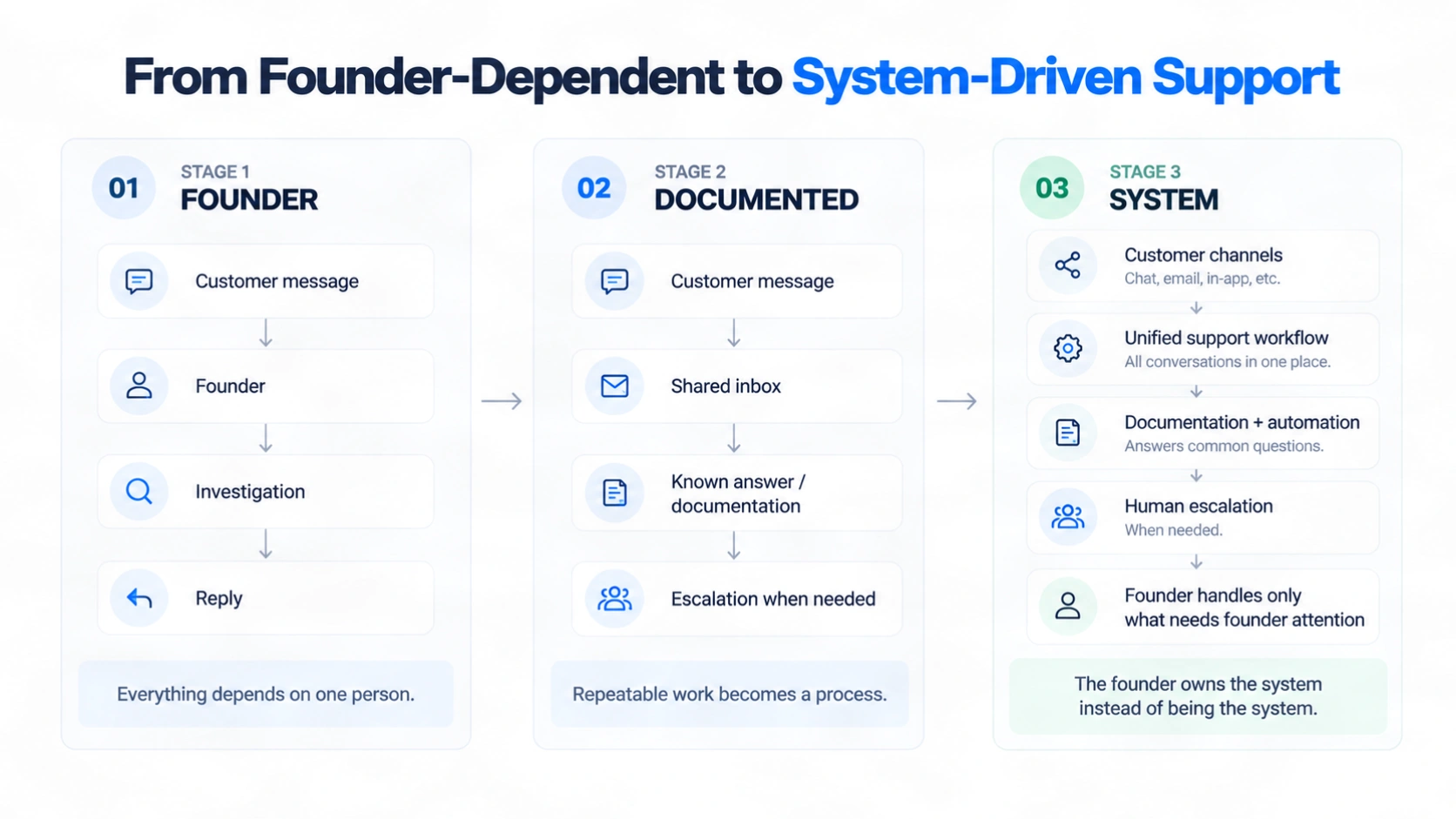
That’s an important difference.
Because doing support yourself is a stage of building a SaaS.
It isn’t a failure.
And needing a system doesn’t mean you care less about customers.
It means you’re building a company where customers can get help without the entire company stopping every time someone asks a question.
The support team may still be you for a while.
But it doesn’t have to stay that way.
A better way to think about founder-led support
You don’t need to choose between doing support yourself and not caring about support.
There is a middle ground:
Know the customer. Build the system. Keep the human when it matters.
That’s how support can grow with the SaaS instead of growing around the founder.
Frequently asked questions
What is founder-led support?
Founder-led support is when the founders of an early-stage SaaS personally answer customer messages, investigate problems, explain the product and follow up when a fix is ready. Early on it gives direct access to customers and works as product research: it shows where people hesitate, get confused or expect something different.
What is the difference between founder-led and founder-dependent support?
Founder-led support means the founder learns from support conversations. Founder-dependent support means support only works when the founder personally handles every conversation. The first is useful; the second is not sustainable, because as volume grows support starts deciding what the founder works on.
When should a SaaS founder stop doing customer support themselves?
There is no universal customer count. The signals are response times regularly slipping, the same questions arriving month after month, support interrupting product development, avoiding the inbox, or customers waiting simply because the founder is the bottleneck. Hand over the documented half first and keep unusual problems and product-level issues close to the founding team.
What should a founder do before buying a customer support tool?
Five things: put every customer conversation in one place, find the five questions you are tired of answering, write clear answers to them, decide what should never be automated, and set response expectations you can actually keep. None of it requires buying anything — it takes an afternoon.
What customer support should be automated, and what should not?
Automate questions that are repetitive, factual, documented and predictable — password resets, product information, setup instructions, known troubleshooting and business hours. Keep a clear path to a human for angry customers, billing disputes, security issues, unusual bugs and anything that needs judgement. If the system does not know the answer, it should hand over rather than invent one.
What should be in place before the first support hire?
Common questions documented, clear escalation rules, one place to see conversations, realistic response expectations and a basic handoff process. Without them you have not hired a support person — you have hired another person to experience the same chaos.
How can a founder handle support without it taking over the day?
Give support a rhythm: a five-minute morning pass, fixed support blocks during the day instead of answering every notification, a weekly fifteen minutes to turn one repeated question into a proper answer, and a monthly read of conversations as product feedback.